
November 2024
Steinway pianos have long been associated with quality craftsmanship and rich sound. However, like any well-used instrument, Steinway pianos are not immune to the effects of time. Many vintage Steinways, despite their reputation, eventually require significant repair and restoration to continue performing at their best. At Faust Harrison Pianos, we specialize in restoring these instruments, recognizing both their strengths and their weaknesses.
Evaluation and Planning
Restoring a Steinway piano involves a detailed and careful process. Over time, even the finest pianos can suffer from worn-out action parts, weakened soundboards, and damaged finishes. The restoration process starts with a thorough assessment to determine the extent of the wear and tear. For many Steinway pianos, this evaluation uncovers issues that go beyond routine maintenance, requiring a deep dive into restoration.
Soundboard Restoration or Replacement
One of the most important elements of a Steinway piano is its soundboard, which plays a crucial role in its tone and resonance. Many older Steinway pianos have soundboards that have cracked or lost their crown, the arch necessary for sound projection. At Faust Harrison, we carefully evaluate whether the original soundboard can be restored or if it needs replacement. Our goal is to ensure that every Steinway we restore sounds as vibrant as it did when it was first built.
Action Overhaul
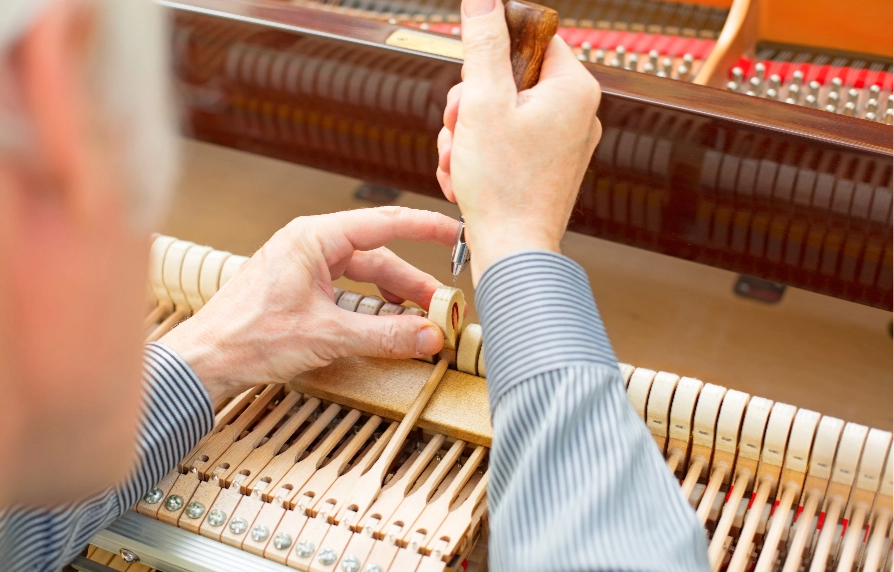
The action mechanism of a Steinway piano, which includes hammers, dampers, and keys, often wears down with use. This can lead to a loss of responsiveness and inconsistent touch. When restoring a Steinway piano, we replace worn-out components with either authentic Steinway parts or parts made to the original specifications. This helps return the instrument’s touch and playability to a level that allows musicians to fully enjoy their Steinway piano again.
Restringing and Regulating
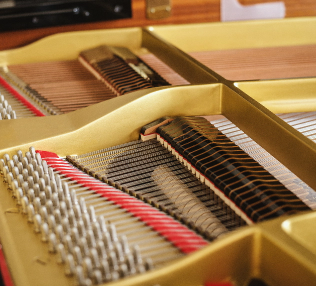
Another critical step in the restoration process is restringing. The strings of a Steinway piano are essential for creating its characteristic tone, but over time, strings lose their elasticity and tension. Restringing a vintage Steinway involves carefully installing new strings and ensuring proper tension across the keyboard. This step is vital for achieving the full, rich tone that Steinway pianos are known for, even after decades of use.
Cabinet Refinishing
Beyond the technical repairs, the visual appeal of a Steinway piano is also addressed in restoration. Many Steinways show wear in their cabinets, with scratches, chips, or fading finishes. At Faust Harrison Pianos, our team refinishes the piano’s cabinet to restore its original beauty. Whether it’s an ebony finish or a unique wood veneer, we aim to bring out the best in the piano’s appearance while maintaining its historical authenticity.
Final Voicing and Tuning
While restoring a Steinway piano, the final steps are voicing and tuning. Voicing ensures that the newly installed hammers produce an even and balanced sound across the keyboard. Tuning brings the piano to concert pitch, allowing the instrument to perform at its peak. These final touches are crucial in ensuring that the Steinway piano not only looks restored but also plays and sounds as it should.
At Faust Harrison Pianos, we recognize that Steinway pianos, despite their high regard, often need extensive work to maintain their performance and value over time. Our restoration process blends traditional craftsmanship with modern expertise to ensure that each Steinway piano we restore is not only functional but also has the potential to last for many more years.